
Dry Parenting
The case for a little drought.
I am terrible with plants. I can’t say I have a black thumb—it’s more like a black hand. What’s my crime? Overwatering. I can’t stop. It always seems like the plant needs more water. So I water. The next day, leaves feel dry, seems like more water would help. I try ice cubes, spray bottles, little hacks to curb my obsession.
But it’s only a matter of time. More water.
Dead plant.
For our ten-year anniversary, my husband and I went to Napa for a quick celebratory weekend. He picked a winery I had never heard of: Dominus Estate. It was stunning. We toured the property, learned about the architecture, the land, the sun exposure, the family history; but, most of the detailed narrative washed over me….
…except for one term:
Dry farming.
Dry farming is an agricultural technique for cultivating crops without irrigation. Translation: growing crops with no added water.
The premise is simple and extreme—create a controlled (but stressful) environment that forces plants to rely entirely on the soil’s natural moisture.
The result?
Deeper roots. Sweeter fruit.
Less water → more resilient roots → better outcomes.
Less = more.
In the cellar, the vintner showed us the difference between a dry-farmed root and a traditionally irrigated one. The image seared into my mind.
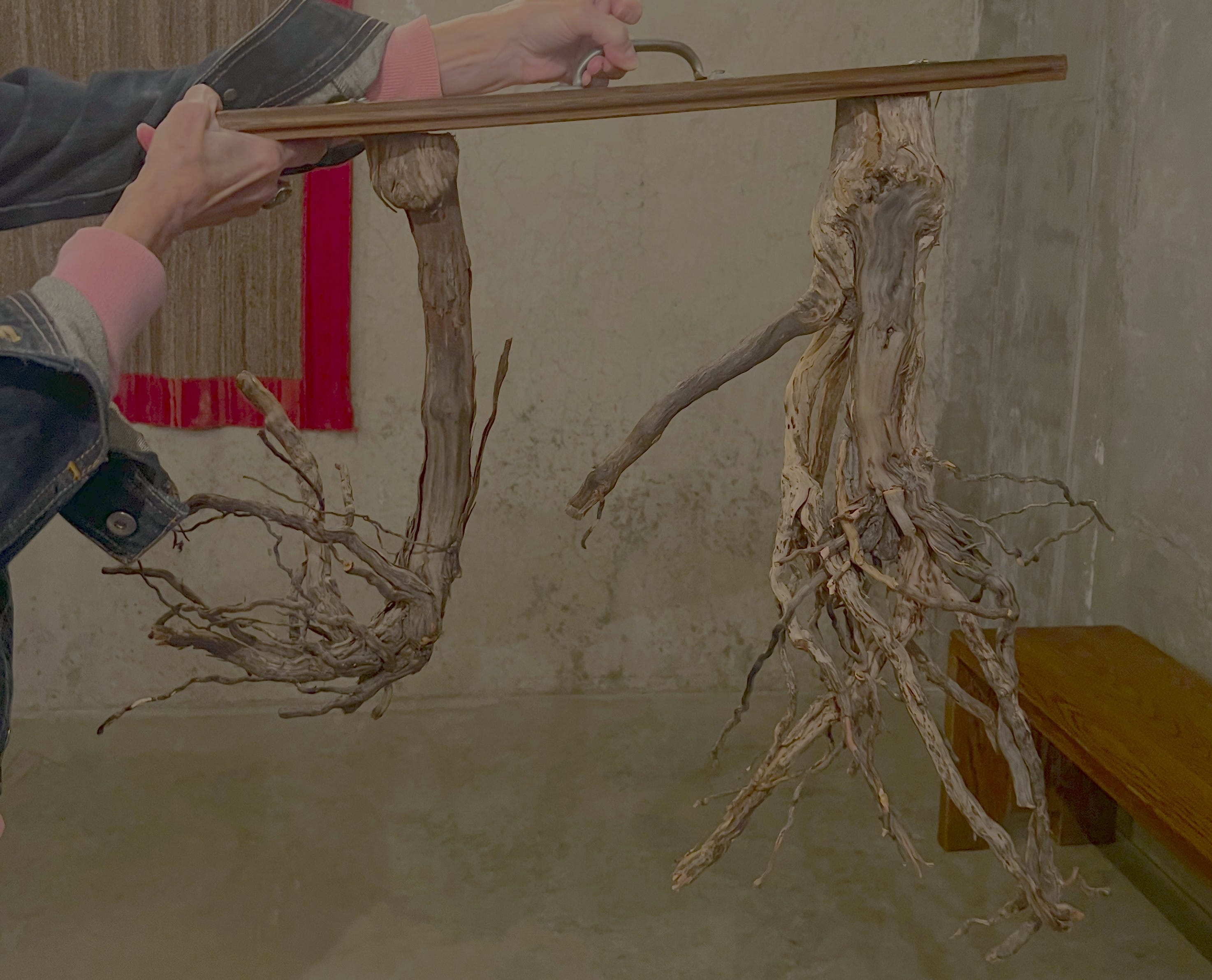
The dry-farmed root (right side) was deep, straight, and confident in its direction. The irrigated root (left side) curved awkwardly sideways, reaching toward where I imagine the drip system dutifully delivered water on a predetermined schedule.
No further analysis needed. It is obvious why one produced better fruit.
And, as usual, my mind went straight to…my kids.
There have been so many terms over the years to describe a spectrum of “over-watering” kids: Tiger Parenting. Helicopter Parenting. Gentle Parenting. Even Free-Range Parenting!
I most often subscribe to the style I affectionately call Lawnmower Parenting, where we proactively mow down every possible obstacle so our kids can move through life on perfectly trimmed, frictionless, USGA putting-approved ground.
I’m not proud of this behavior, but what can I do (I love watering my plants!)?
But seeing the clear image of the strong deep roots versus the crippled weak roots, I felt myself panic.
Am I helping my kids with my extra loving efforts? Or am I just overwatering?
Am I supposed to manufacture challenges?
Induce suffering?
Withhold resources on purpose?
Is dry parenting actually better than my expertly-executed irrigated parenting?
I think <uncomfortably> I know the answer is yes.
Constraints always produce better outcomes.
In life. In entrepreneurship. In creativity. In parenting.
Constraints spark imagination and build resilience.
They force prioritization. Concentrate effort.
They reveal true strengths (and weaknesses).
Failure isn’t just important—it’s necessary for growth. But when everything is easy, when water is always available, it’s impossible to know how much thirst you can handle. Hard to know where your strengths lie. Hard to commit to the work required to grow strong roots.
Now, I don’t think I’m arguing for deprivation or romanticizing struggle.
I’m just questioning excess comfort. Where is the line between being helpful and encouraging, and actually depriving someone of the chance to prove (to themselves most importantly) that they can do something on their own.
Given my love of failure as a wonderful directional guide for the best next step, my goal has never been to raise the most comfortable, compliant children. I’ve always aimed to raise resilient, confident, curious children.
Success as a parent (to me) is raising my kids to have roots robust enough to tolerate a drought… and maybe even beyond tolerate, but thrive in a drought, when others start to panic and shut down. Success is teaching them how to get creative, when water is scarce, what else is there to use? How can we do more with less? How can we conserve strategically not to induce shut down but to pace ourselves to prepare for the right time to re-engage?
It’s honestly no different from the founders I work with — the ones who survived the 2020 covid → 2021 bubble → 2022 burst → 2023/2024 reckoning market rollercoaster and are still here today are the most resilient and successful teams out there (Oura and The Farmer’s Dog being tops on that list!). They’ve been through it all, and nothing phases them. More than that, they have so much confidence in being able to weather the storms that every decision is made with 5 backup plans both to the upside and downside.
But back to the kids…
How does one manufacture that type of “market volatility” when it doesn’t exist?
My kids have whatever, whenever they need and want, and there is no one to blame for any excess in their lives but me (and my husband - and I can def just pile more blame on his side:). I suppose at some point, challenge and constraints will emerge naturally; but I fear they will not have the situational awareness to know what to do… I can only hope that those moments will be the great teaching opportunities for them to figure it out.
So here’s to a little drought in all of our lives, just enough to remind ourselves we can weather any hard times that come our way.
Xx
Such a good point you're making about finding that line between being helpful and hovering. Just the fact that you're actively contemplating it is probably a crucial step. Also, a good reminder that parenting is as much about caring for your kids as it is about learning about yourself. This not-watering metaphor is so rich!